 About us

Breaking from proprietary architecture to lead 'open standard' - targeting 2027 vehicle integration
Securing design flexibility - parallel operation with existing 'TriCore'
(Seoul=Yonhap Infomax) Young Sook Yoon - Infineon Technologies, the world's leading automotive semiconductor supplier with the largest market share, has declared a paradigm shift in the software-defined vehicle (SDV) market by launching the industry's first RISC-V-based automotive microcontroller (MCU) product family.
The strategy aims to maximize design autonomy for original equipment manufacturers (OEMs) and accelerate innovation through 'open standards' that are not dependent on specific vendors.
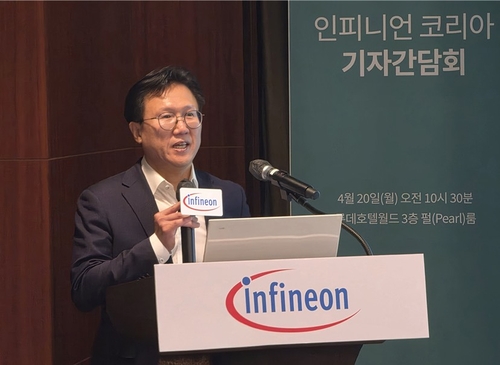
"The Linux of Semiconductors and a Tailored Suit" - Maximizing Efficiency
Infineon held a press conference at Lotte Hotel World on Olympic-ro, Songpa-gu on the 20th, announcing plans to launch a product family incorporating RISC-V architecture into its next-generation automotive MCU 'AURIX™' portfolio.
RISC-V is an open-source instruction set architecture (ISA) available to anyone, which Infineon defines as "the Linux of semiconductors and a tailored suit."
Choi Jae-hong, Vice President and Head of Technology for Infineon Technologies Korea's Automotive Division, explained, "If existing ISAs are like ready-made clothes that must be worn as designed, RISC-V is a modular form where you can include only necessary functions and exclude unnecessary ones." He added, "Hardware-level safety design is easier, making it advantageous for ISO 26262 and ISO 21434 certification compliance, and it has scalability to handle everything from sensor data processing to high-performance AI control with the same architecture."
In particular, this introduction reflects the automotive industry's demand to resolve dependency on specific vendors. The aim is to break free from passive vendor responses during royalty issues or supply chain instability, allowing OEMs to secure the initiative to directly define and design desired functions.
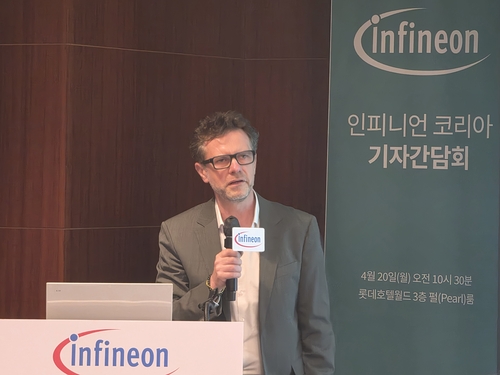
Parallel Coexistence with TriCore - 2027 Road Deployment Target
Infineon made clear that the RISC-V introduction does not replace its existing flagship architecture 'TriCore™'.
Thomas Boehm, Senior Vice President of Infineon's Automotive Microcontroller Division, emphasized, "The era of sequential core generation replacement is over," adding "TriCore has mass production plans until 2040 and will coexist in parallel with RISC-V, complementing each other."
In fact, BMW is implementing the latest zonal architecture using Infineon's next-generation product 'TC4-X' (TriCore-based), and Infineon projects that RISC-V-based vehicles will begin hitting the roads in earnest from 2027.
Major domestic customers including Hyundai Motor Company are reportedly strategically reviewing RISC-V adoption for SDV and AI-based new functions while maintaining existing TriCore assets.
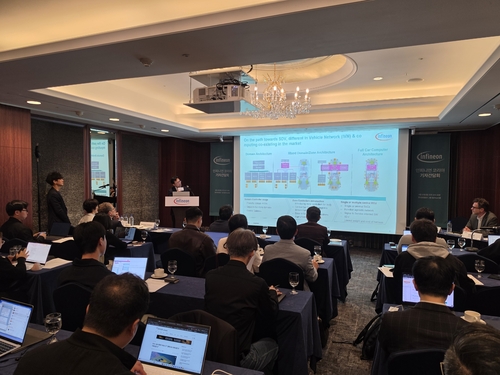
Ecosystem Expansion Through Quintauris - "Coexistence Rather Than Competition" with ARM
Infineon is leading RISC-V industry standardization through 'Quintauris', jointly established with global semiconductor companies.
Vice President Boehm stated, "Standardization is essential as software tools incur high costs," adding "We are defining standard profiles that can be smoothly applied worldwide through Quintauris."
Additionally, Infineon has prominently featured 'Virtual Prototype' technology that allows software verification in a virtual environment before actual chip shipment. This enables customers to realize 'shift-left' by simultaneously conducting hardware and software development, dramatically shortening new vehicle launch periods.
Regarding concerns about reducing ARM architecture proportion, Infineon drew a line, stating "This is not a confrontation with ARM, and we will coexist well in the market." However, they explained that investment in RISC-V, which has superior scalability and cost structure, was essential considering the capacity to support vehicle innovation 10-15 years ahead.
Infineon plans to solidify its RISC-V ecosystem leadership based on its current 36% automotive MCU market share.
Vice President Boehm anticipated that beyond automobiles, the technology could be readily utilized in robotics and Physical AI fields with similar technical structures.
ysyoon@yna.co.kr
(End)
Copyright © Yonhap Infomax. Unauthorized reproduction and redistribution prohibited, AI learning and utilization prohibited
Copyright © Yonhap Infomax Unauthorized reproduction and redistribution prohibited.